

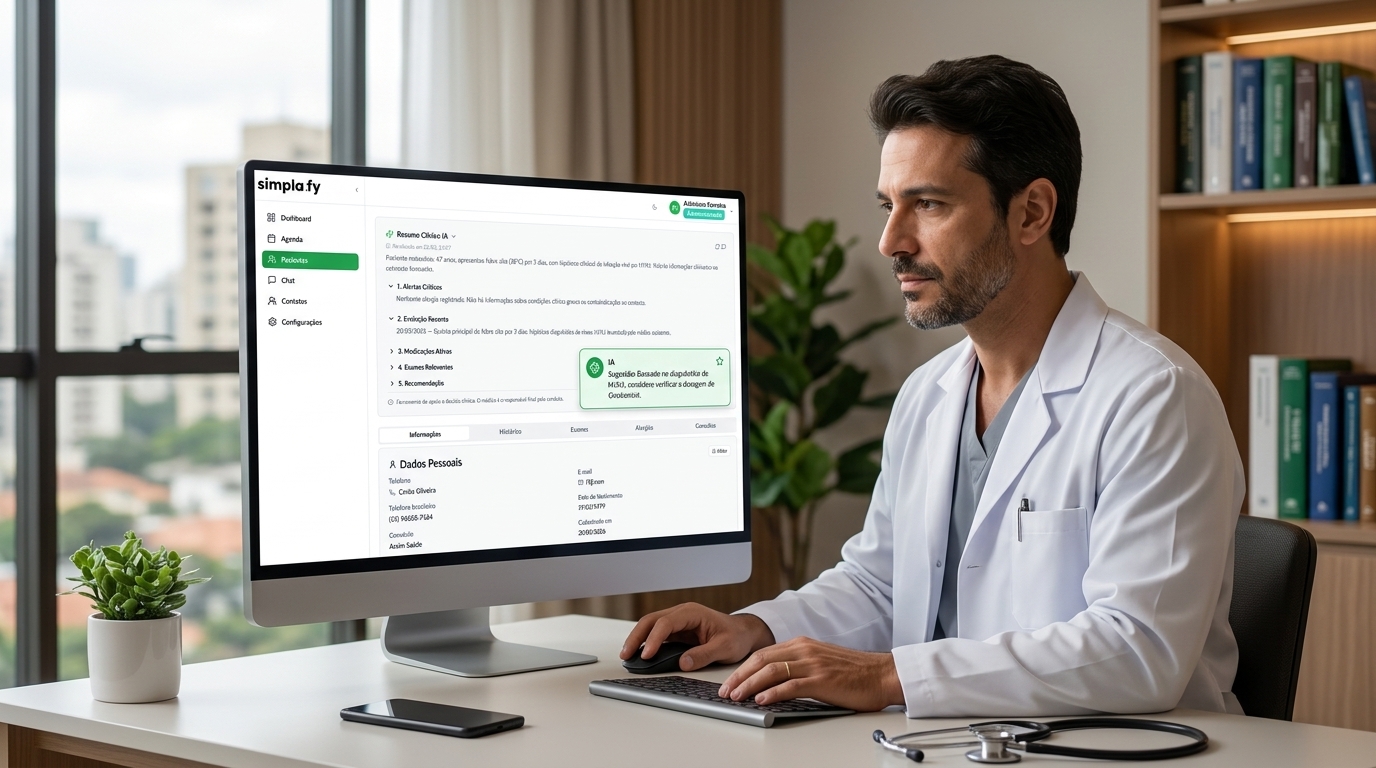
Doctors spend an average of 30 to 40% of each appointment just on documentation. Every progress note written from scratch. Every medical certificate drafted again. When they need an ICD code, a dosage or a treatment alternative, they open Google and leave the system. The March release of Simplafy Health tackles both problems: a central template hub to automate repetitive documentation and two AI agents in the medical record — a smart history summary and a clinical assistant during the appointment. All available on desktop and mobile.
Template hub: one place for everything
Simplafy now has a unified Template Hub in Settings. Three categories organized in tabs: clinical progress notes, WhatsApp messages and medical certificates. The system templates come ready to use — formats such as SOAP, structured anamnesis, follow-up appointment — with a specialty filter for multidisciplinary clinics. The doctor can use the defaults as a base, create custom templates, edit, delete and set which one will be the default for their appointments.
If the template you want doesn't exist when you open a progress note, a contextual link takes you straight to creating a new one without losing the flow of the appointment. For WhatsApp messages, the hub offers six categories: appointment reminder, attendance confirmation, post-appointment satisfaction survey, follow-up for return visits, waiting list notice and free-form templates. The editor shows a real-time preview with variables such as patient name and appointment date already filled in — what the patient will see, before sending.
Smart summary of the patient's history
Before any appointment, the doctor can turn on the automatic history summary. The agent analyzes all recorded progress notes and generates a structured summary in clinical language: main diagnoses and ICD codes, medications in use and
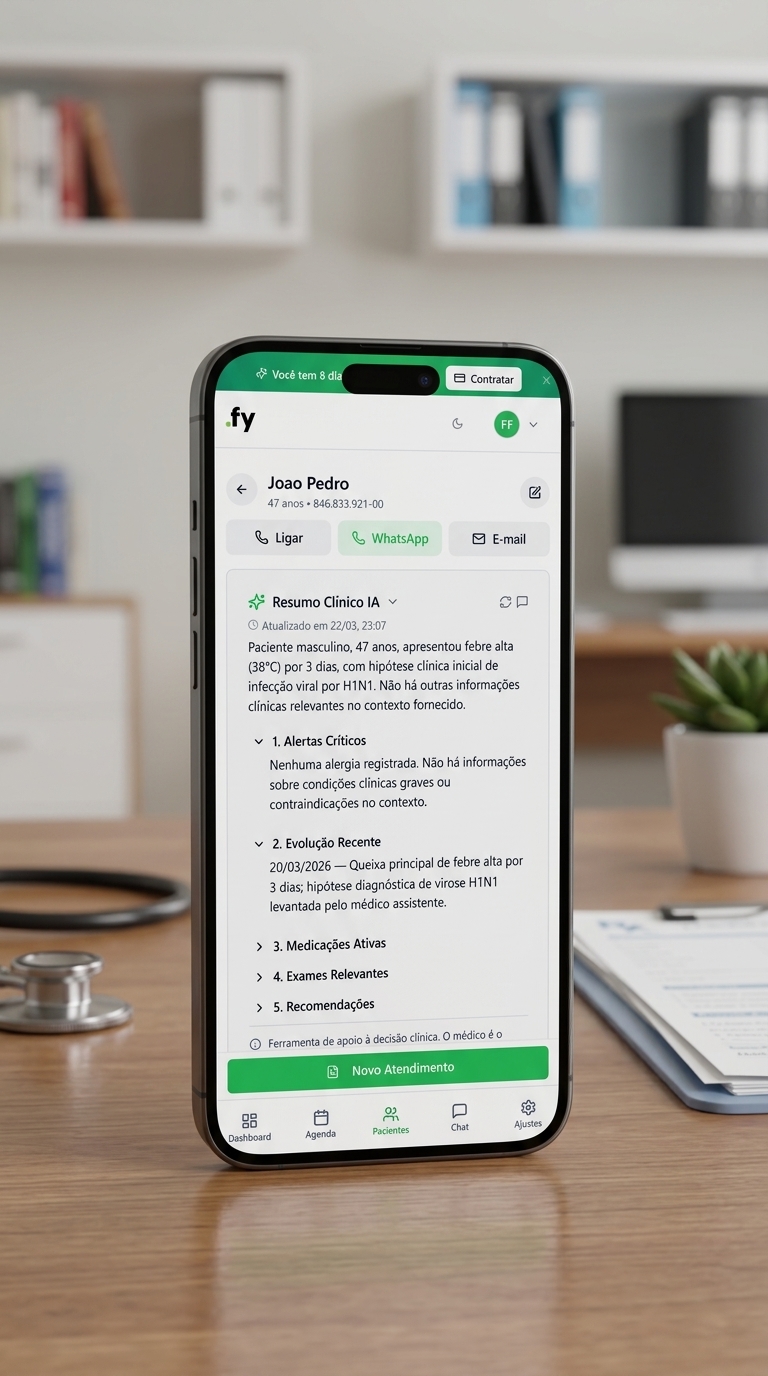
prescription history, last appointment and reason for return, relevant alerts such as allergies, chronic conditions and pending tests. What used to require manually scrolling through dozens of appointments appears in seconds, in a fixed card at the top of the medical record, ready before the patient walks into the room.
Medical assistant during the appointment
Inside the medical record, the doctor has access to a conversational assistant that works like a second pair of clinical eyes. The assistant suggests ICD codes based on the progress note being typed — the doctor reviews and confirms. It answers questions about dosage, contraindications and drug interactions in real time, without leaving the system. It also supports discussion of treatment alternatives: the doctor describes the case and the assistant presents lines of management with supporting evidence, opening room to assess the best decision for that patient.
Simplafy's AI Medical Assistant is a clinical decision support tool. Responsibility for diagnosis and therapeutic management rests entirely with the medical professional, in accordance with the resolutions of the Federal Council of Medicine (CFM). Simplafy does not replace professional clinical judgment.
Why this matters
Templates reduce documentation time per appointment. For a clinic with 20 appointments a day, saving 5 minutes per appointment means 1h40 given back to the doctor — every day. That turns into more appointments, less burnout, better quality of progress notes. With standardized templates, a multidisciplinary clinic ensures that all professionals document at the same level of quality.
Clinical AI is the differentiator. Other systems have an electronic medical record — but not AI integrated into the care flow. Simplafy positions the medical record not as a form to fill in, but as a smart space that supports the appointment. How many times has the doctor opened another tab to look up an ICD code or a drug interaction in the middle of an appointment? That flow breaks.
Everything on mobile
History summary, clinical assistant and templates also work on your phone. The medical record goes with the doctor — in the exam room, in the hallway, at home. The combination of templates and AI represents a shift in positioning: from a management system to a clinical productivity platform.
Want to see how it works in your clinic? Try it free for 10 days at simplafy.com.br/saude — no credit card.
References used to produce this content:
- Simplafy Health launch briefing — March 2026 (Post 3)
- CFM Resolution No. 2.454/2026 — Use of AI in medicine
- CFM classifies AI scheduling as low risk — Simplafy Blog
- Simplafy Health — simplafy.com.br